Hiring a dedicated development team is one of the highest-leverage decisions a growing company makes — and one of the easiest to get expensively wrong. Pick the wrong engagement model and you will pay for idle capacity. Skip the wrong contract clause and you may not own the code you paid for.
This guide walks through the three decisions that actually matter: which model to use, what it should cost, and what the contract must say.
What "Dedicated Team" Actually Means
A dedicated development team is a group of developers who work exclusively on your product, embedded in your process, reporting into your priorities. They join your standups, use your Jira board, and ship against your roadmap.
That exclusivity is the distinguishing feature. It is what separates a dedicated team from a project agency juggling six clients, and what makes the model feel like an extension of your in-house staff rather than a vendor relationship.
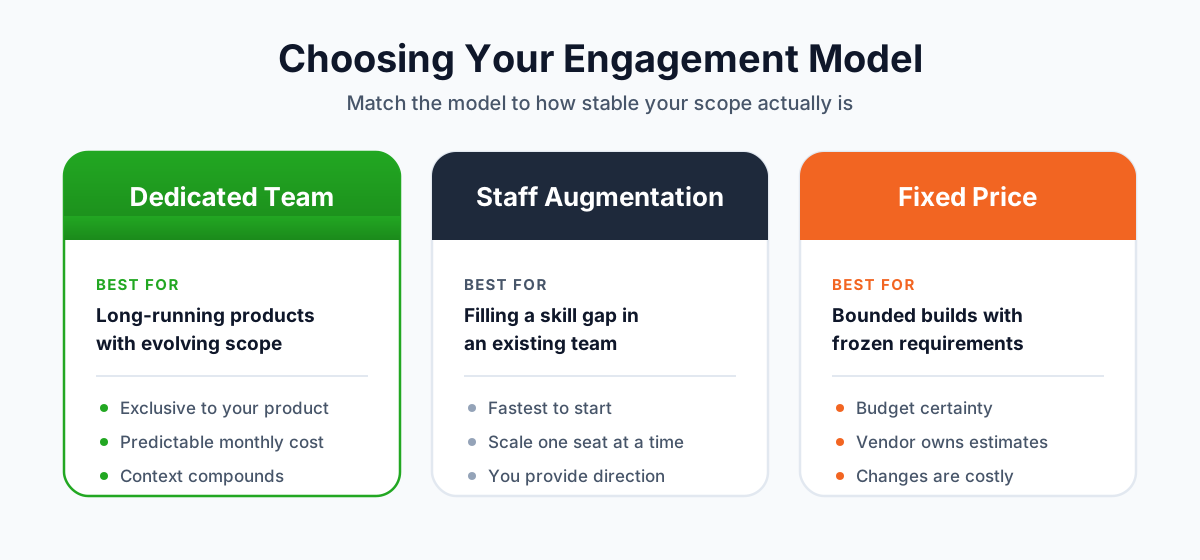
Choosing Your Engagement Model
Most hiring mistakes are really model-selection mistakes. Here is how the three common options differ.
1. Dedicated Team
A full squad — developers, QA, sometimes a project manager — retained on a monthly basis.
Best for: Long-running products, evolving scope, roadmaps measured in quarters rather than weeks.
- Deep product context compounds over time
- Predictable monthly cost
- You direct priorities directly
- Requires enough sustained work to keep the team busy
2. Staff Augmentation
Individual developers who plug into your existing team to fill a specific skill gap.
Best for: You already have engineering leadership and need capacity or a specialist skill.
- Fastest to start — often days
- Scale one seat at a time
- Cheapest entry point
- Depends on your team providing direction and code review
3. Fixed-Price Project
A defined scope, a defined deliverable, a defined price.
Best for: Well-understood, bounded builds — a marketing site, a v1 MVP, a migration.
- Budget certainty from day one
- Vendor absorbs estimation risk
- Change requests are slow and expensive
- Poor fit whenever requirements are still moving
The Quick Decision Rule
| Your situation | Model |
|---|---|
| Scope will change month to month | Dedicated team |
| You have a tech lead, need capacity | Staff augmentation |
| Scope is frozen and documented | Fixed price |
| Building for 6+ months | Dedicated team |
| Filling one specialist gap | Staff augmentation |
| Board wants a single locked number | Fixed price |
The failure mode worth naming: teams choose fixed-price because it feels safe, then discover their scope was never actually frozen. Every change becomes a negotiation, and the "safe" option turns into the expensive one.
What It Costs in 2026
Rates vary enormously by region. These are typical blended hourly ranges for mid-to-senior developers:
| Region | Hourly rate | Monthly (1 FTE) |
|---|---|---|
| United States | $100–$180 | $16,000–$28,800 |
| Western Europe | $80–$140 | $12,800–$22,400 |
| Eastern Europe | $35–$70 | $5,600–$11,200 |
| Latin America | $30–$60 | $4,800–$9,600 |
| India | $18–$45 | $2,900–$7,200 |
Treat these as planning ranges, not quotes — actual pricing moves with seniority, stack scarcity, contract length, and team size.
A Realistic Team Budget
A typical five-person product squad — three developers, one QA, one part-time PM — hired through an India-based partner lands around $18,000–$30,000 per month. The comparable US in-house cost, once you add benefits, payroll tax, equipment, and recruiting amortization, is closer to $70,000–$95,000 per month.
The Costs Nobody Quotes You
The hourly rate is the visible number. These are the ones that surprise people:
- Onboarding ramp — expect 2–4 weeks before full productivity. Budget for it.
- Management overhead — someone on your side owns this relationship. That is real time.
- Tooling and licenses — seats for Jira, GitHub, Figma, IDEs, cloud environments.
- Overlap hours — demanding heavy timezone overlap often carries a premium.
- Replacement risk — if a developer rotates off, context is lost and partly rebuilt.
A useful planning heuristic: add 15–20% on top of the quoted rate to reach true cost.
Contracts: The Clauses That Matter
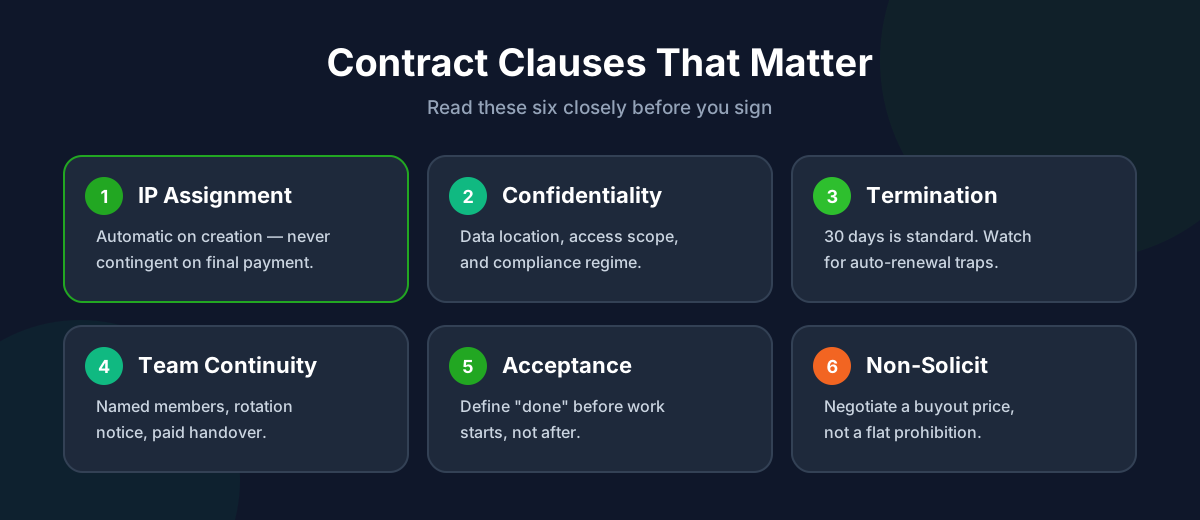
Most development contracts are boilerplate until something goes wrong. These are the clauses to actually read.
IP Assignment
The single most important clause. It must state that all work product transfers to you, and that transfer must be present-tense and automatic on creation — not contingent on final payment.
Verify it explicitly covers work by subcontractors. If your vendor uses any, and their agreements do not chain the assignment through, there is a gap in your ownership.
Confidentiality and Data Handling
Beyond a standard NDA, specify: where your data may be stored, who may access production systems, what happens to copies on termination, and which compliance regimes apply (GDPR, SOC 2, HIPAA) if any touch your product.
Termination and Notice
Standard is 30 days for a dedicated team. Watch for auto-renewal clauses that quietly lock you into another quarter, and confirm what you owe on early termination.
Team Continuity
Your team's value is accumulated product context, so protect it. Ask for: named team members in the contract, advance notice before rotation, a paid handover overlap, and a cap on how many people can change per quarter.
Acceptance Criteria
For fixed-price work especially, define what "done" means before work starts — test coverage, performance thresholds, browser support, review window length, and what happens when something is rejected.
Non-Solicitation
Vendors will want protection against you hiring their staff directly. This is reasonable — but negotiate a buyout clause. If the relationship works and you want to bring someone in-house permanently, there should be a defined price rather than a flat prohibition.
The Vetting Process
Resumes and hourly rates predict outcomes poorly. This sequence predicts them much better.
1. Define Before You Search
Write down the stack, the seniority level, the timezone overlap you truly need, and how you will measure success at 90 days. Vague requirements produce vague candidates.
2. Evaluate the Company First
Before assessing individual developers, assess the partner: How do they source and vet? What is their annual attrition? Can you talk to a reference client on a similar engagement? What happens when someone underperforms?
3. Then Assess the Developers
Interview the specific people who will work on your product — not a sales-stage bench. A code review discussion of their past work reveals far more than an algorithm puzzle. Probe communication directly; it fails more engagements than technical skill does.
4. Run a Paid Trial
Two to four weeks on a real, low-risk piece of your backlog. This is the only step that tests the thing you actually care about: whether they ship well inside your codebase and your process.
Many firms — Apzzo included — offer a risk-free trial period for exactly this reason.
5. Onboard Deliberately
Give them the same onboarding an in-house hire would get: architecture walkthrough, environment setup docs, coding standards, a named point of contact, and a first ticket small enough to complete in week one.
Red Flags
Walk away, or at least slow down, when you see:
- No named developers before signing — you are buying a bench, not a team
- Rates far below regional norms — usually junior developers billed as senior
- Resistance to a trial period — confident partners welcome the test
- IP assignment conditioned on final payment — leaves you exposed in a dispute
- No direct developer access — every question routed through an account manager
- Vague team continuity terms — your context can be rotated away without notice
Making the Decision
Choose the model that matches how stable your scope actually is, not how stable you wish it were. Budget the real cost, not the quoted rate. Read the IP, termination, and continuity clauses closely. And always run a paid trial before committing to a long engagement.
Get those four things right and a dedicated team becomes what it should be — a durable extension of your product organization rather than a vendor you manage at arm's length.
Building out your team? Talk to Apzzo Technologies about a dedicated squad, or explore our hire developers options across React, Node.js, Python, Flutter, and more.
